IYA2009 Updates
TWAN Updates
11 January 2011
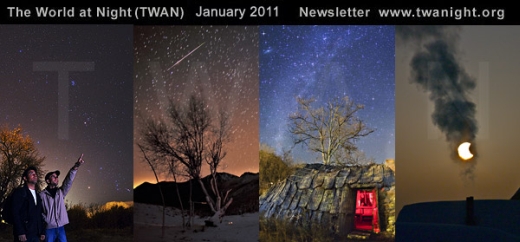
News and Report
- Happy New Year 2011! Enjoy our special gallery for the new year greetings featuring the best TWAN images of night sky above winter landscapes.
- TWAN at Central European Deepsky Imaging Conference (CEDIC 2011), The conference is a major annual gathering of astrophotographers from Europe and around the world in Linz, Austria. TWAN director Babak Tafreshi will present The World at Night and hold a workshop on landscape astrophotography at CEDIC2011 which takes place March 18 – 22. Conference registration is open through February.
- TWAN in Beautiful Universe and SkyWatch 2011, The World at Night images are featured in two popular publications of Sky&Telescope magazine: Beautiful Universe and SkyWatch which are published annually.
- Top Viewed Photos and Videos: October-December 2010, See the most visited photos and time-lapse videos on TWAN website during fall 2010.
- New TWAN Mystery, Test your knowledge of the night sky with this edition of TWAN Mystery.
There are new stunning photos and time-lapse videos on the TWAN website, featuring starry nights of our planet's landmarks from around the world:
Africa
Libya
- Skylights Over Libya by Tunc Tezel
Spain
- The Winter Solstice by Juan Carlos Casado
Tanzania
- Sky From the Equator by Kwon O Chul
Americas
Canada
- Eclipse and Aurora in Motion (time-lapse video) by Yuichi Takasaka
- Aurora During a Total Lunar Eclipse by Yuichi Takasaka
- Lunar Eclipse above Yellowknife by Yuichi Takasaka
- Sky Gem by Yuichi Takasaka
- Quadrantid Meteor Above Alberta by Yuichi Takasaka
- Streak From the North by Yuichi Takasaka
Costa Rica
- Eclipsed Moon From a Cruising Ship by Wally Pacholka
USA
- Lunar Eclipse Picnic by Dennis Mammana
- Meteor Above Mojave Desert by Wally Pacholka
- Stars Above a Joshua Tree by Wally Pacholka
- Winter View by P.K. Chen
- Summer View by P.K. Chen
- Autumn View by P.K. Chen
- Spring View by P.K. Chen
- Sky of Four Seasons by P.K. Chen
Asia
Korea
- Leonid Meteors and Their Persistent Trains (VR/video) by Kwon O Chul
Russia
- Siberia Eclipse Sunset by Aleksandr Yuferev
- Frozen Eclipse by Aleksandr Yuferev
- Chimney Eclipse by Aleksandr Yuferev
Australia and Pacific
Chile
- Back to the History by Stephane Guisard
Europe
France
- Unusual Sunrise by Laurent Laveder
- Port Orion by Gernot Meiser
- A Winter Night of France by Gernot Meiser
- Startrails Above Tour Vauban by Gernot Meiser
- Moon Dream by Gernot Meiser
Greece
- Wandering Sun by Anthony Ayiomamitis
- Analemma Above the Temple of Poseidon by Anthony Ayiomamitis
Hungary
- Analemma over Hungary by Tamas Ladanyi
- Framing by Fibonacci Numbers by Tamas Ladanyi
- Misty Eclipse by Tamas Ladanyi
Spain
- Christmas Stars by Juan Carlos Casado
- Solar Eclipse Above Spain by Juan Carlos Casado
Sweden
- Star Trails in the North by P-M Heden
- Geminid Meteors above Sweden by P-M Heden
- Family Stargazing by P-M Heden
- Noctilucent Clouds above Sweden by P-M Heden
- Halloween Night by P-M Heden
- Night in the Land of Gustav Vasa by P-M Heden
- New Year Sky Dreams by P-M Heden
- Jupiter Corona by P-M Heden
Middle East
Iran
- A Meteor Moment by Amir H. Abolfath
- The World at Night in Black and White by Oshin D. Zakarian
- Morning Trails by Oshin D. Zakarian
- Village Night by Amir H. Abolfath
- Zodiacal Light in Desert Sky by Amir H. Abolfath
- Clear Sky After Snow (VR/video) by Babak A. Tafreshi
- December Meteors by Babak A. Tafreshi
- Big Dipper and the Falling Star by Babak A. Tafreshi
- Sky Above Iran National Observatory by Babak A. Tafreshi
- Milky Way in a Moonlit Night by Babak A. Tafreshi
- The Belt of Venus by Babak A. Tafreshi
- Orion and the Persian King by Babak A. Tafreshi
- Around the Pole by Babak A. Tafreshi
- Meteor Shower of December by Babak A. Tafreshi
- The Night Begins by Oshin D. Zakarian
- Starry Winter Landscape by Babak A. Tafreshi
- Village Sky and Shooting Star by Amir H. Abolfath
- Sky Watchers of the Astronomy Town by Babak A. Tafreshi
- Falling Star of an Ancient City by Babak A. Tafreshi
- Stars and Meteors above Qumis by Babak A. Tafreshi
- Damghan Meteor by Amir H. Abolfath
- Trails Above Tehran by Amir H. Abolfath
- Bears in the Desert Sky by Amir H. Abolfath
- Sky Motion Above a Mountain Road by Amir H. Abolfath
- Starry Night of Damghan Desert by Oshin D. Zakarian
- Colors of Autumn by Oshin D. Zakarian
- A Fire Temple at Night by Amir H. Abolfath
- Sky in Motion above Ancient Fire Temple (VR/video) by Amir H. Abolfath
- Stars and Rocks by Oshin D. Zakarian
- Planets in the Morning Twilight by Oshin D. Zakarian
The Guest Gallery is a well-received section on the TWAN website, featuring selected outstanding Earth and sky photos by non-TWAN creative photographers from around the globe. If you have such remarkable photos to share with the TWAN Guest Gallery then please contact us. There are new featured photos in the Guest Gallery:
- Night at Alanya Castle (Alanya, Turkey) by Hakan Buyuktuncay
- Korean Ruin and Star Trails (Korea) by Kang Jisoo
- Venus in Twilight (Zahedan, Iran) by Masoud Sheikh Veisi
- Quadrangle after Sunset (Tempe, AZ, USA) by Jin Lu
- Lights of the Albufeira Star Party (Lagoa de Albufeira, Sesimbra, Portugal) by Miguel Claro
- Hareer Mountains in Autumn (Erbil, Iraq) by Azhy Hasan
- Ursa Major over the Canyzar Lagoon (Villarquemado, Teruel, Spain) by Vicente Aupi
- Leh Panorama (Hanle, Ladakh, Jammu & Kashmir, India) by Ajay Talwar, Vikrant Narang, Raghu Kalra
- Small Magellanic Cloud and Uluru (Northern Territory, Australia) by Kang Jisoo
- Varzane Moon and Venus Conjunction (Varzane, Isfahan, Iran) by Nazanin Alibeik
- Present Look at the Past (High Island Reservoir, Sai Kung, Hong Kong) by Herman Yeung
- Gahar Lake in the Moonlight (Gahar Lake, Lorestan province, Iran) by Saber Karimi
- Eclipsed Moon Setting (Neuhofen an der Krems, Austria) by Herbert Raab
- Moonrise Partial Lunar Eclipse (Mandaluyong City, Philippines) by Erika Valdueza
- Devsthal Meadow (Devsthal, Uttarakhand, India) by Ajay Talwar
- Uluru at Night (Ayers Rock(Uluru), Northern Territory, Australia) by Kang Jisoo
- Waxing Crescent Moon meets Venus (Kurdistan, Iran) by Farzin Hossaini
- Three friends of the Milky Way (Portinho da Arrabida, Sesimbra, Portugal) by Miguel Claro
- Lazar Castle At Night (Lazarea Village, Transilvania, Romania) by Munzlinger Attila
- Aurora over Alaska (Willow Lake, off Richardson Highway, Alaska) by Paul Alsop
- Pleiades over Moutohora (Thornton Beach, New Zealand) by John A Davis
- Transparent Observatory (Hanle, Ladakh, Jammu & Kashmir, India) by Ajay Talwar, Vikrant Narang, Raghu Kalra
- Panorama of the Milky Way (Gayen, Iran) by Amirreza Kamkar
- Sydney at Dawn (Sydney, NSW, Australia) by Kang Jisoo
- Ostersund by Night (Ostersund, Sweden) by Goran Strand
- Garmeh Star Trail (Garmeh Village, Isfahan, Iran) by Hooman Mirrahimi
- Our Galactic Neighborhood (Azul, Argentina) by Luis Argerich
- Amateur Astronomer at Work or Pleasure? (Hatu Peak, Shimla, Himachal Pradesh, India) by Ajay Talwar
- Partial Solar Eclipse at Sunrise (Vienna, Austria) by Peter Wienerroither
- Partial Eclipse from France (La Rosiere, France) by Sebastian Voltmer
Astronomy Picture of the Day (APOD), a NASA’s world-known website, has featured new images by TWAN photographers:
- Sunset, Moonset by Aleksandr Yuferev
- Analemma 2010 by Tamas Ladanyi
- Skylights Over Libya by Tunc Tezel
- Star Trails in the North by P-M Heden
- A Meteor Moment by Amir Abolfath
- Leonids Above Torre de la Guaita by Juan Carlos Casado
- Meteor in the Desert Sky by Wally Pacholka
TWAN is featuring 14 special galleries:
- Latest Images
- Winter Nights
- Cosmic Motions
- Our Cosmic Neighbor (Moon)
- Milky Way
- Meteors
- Comets
- Eclipses
- Aurora
- Virtual Reality
- Dark Skies Importance
- World Heritage Sites
- TWAN APODs
- TWAN on National Geographic News
TWAN is a global program of Astronomers Without Borders (www.astrowb.org) and a Special Project of International Year of Astronomy, an initiative by IAU and UNESCO. The World at Night is to produce and present a collection of stunning photographs of the world's most beautiful and historic sites against the nighttime backdrop of stars, planets and celestial events. The eternally peaceful sky looks the same above all symbols of different nations and regions, attesting to the truly unified nature of Earth as a planet rather than an amalgam of human-designated territories.
Building bridges through the sky
The World at Night
www.twanight.org
Virtual Telescope introduces new, amazing instruments for observing the Cosmos live through the Int
11 January 2011
After four years since it was officially launched in 2006, the Virtual Telescope project (www.virtualtelescope.eu) introduces a new important telescope, accessible via the Internet by professional and amateur astronomers from all around the world. Initially equipped with a 280mm-aperture, remote telescope, later the Virtual Telescope hosted a Celestron 356mm-large scope, installed on a Paramount ME robotic mount and completed with a SBIG SBIG ST8-XME, class 1 CCD camera, plus filters.
This setup has shown incredible capabilities, thanks to its advanced specifications and to the excellent seeing conditions at the observing site (Ceccano, Italy), with an average seeing of 1.7 arcseconds and peaks of just 1 arcseconds. The instrument, accessible through the web interface of the Virtual Telescope project, has shown the sky for free to about 800.000 individuals from 192 different Countries, almost reaching the totality of the worldwide community. Over the last two years, about 100 international, free events where planned. These numbers make the Virtual Telescope the most active, remote astronomical facility on the planet.
These outstanding results pushed the Virtual Telescope staff to evaluate the acquisition of another system, able to enhance further both the public and research activities. A glorious telescope was finally acquired, based on a PlaneWave 17”, corrected Dall-Kirkham optical tube assembly, with a high luminosity and wide corrected field. This optics was installed on another Paramount ME robotic mount and equipped with a SBIG STL-6303E, large format CCD camera and filters. This is the only instrument of this kind installed in Italy and one of the first ones in the world: it sports outstanding optical, mechanical and electronic features.
Both the robotic telescopes now part of the Virtual Telescope project are independently and remotely accessible and they are connected to the Internet with two independent, broadband connections, for the highest real-time control performances. The whole system is served by a network of four computers, controlling the telescopes, the environmental and weather conditions, the observatory facilities and doing the image/data reduction.
“We are very happy with the amazing, growing international success we experienced since we started sharing the Cosmos”, says Gianluca Masi, astrophysicist, owner and scientific director of the Virtual Telescope project: “The new instruments will give a great boost to all our activities, confirming the leadership of this project, which has staked a lot on quality and professionalism of our services and contents.
To celebrate these recent improvements, the Virtual Telescope will host, on the next 25 Jan. 2011 at 20:00 Universal Time, a special online, free event, when our instruments will show in real-time some of the most beautiful cosmic jewels, with the live comment of our scientific team. To join, a computer connected to the Internet is all what is needed, to enter our website (www.virtualtelescope.eu) at the given date and time. Participants will have a chance to win a prize consisting in two hours of free observing time, using our new system!
Contacts:
Dr. Gianluca Masi, PhD
Email: gianluca@bellatrixobservatory.org
Mobile.: +39 334 9236690
Fax: +39 07751800105
Proceedings Published From 2009 Women in Astronomy Conference
11 January 2011
The Organizing Committee of the 2009 Women in Astronomy conference has published the proceedings from the year's Women in Astronomy and Space Science Conference III, titled "Women in Astronomy and Space Science 2009: Meeting the Challenges of an Increasingly Diverse Workforce." The conference was held on Oct. 21-23, 2009, at the Inn and Conference Center, University of Maryland University College, Adelphi, Md.
Nearly three hundred women and men attended the three day conference, which focused on the diversity of today's scientific professions and the challenges of tomorrow's leaders. Speakers shared their personal route to careers in areas such as instrument development, science management, non-profit organizations, and aerospace administration. Topics presented included: best practices for recruiting, promoting, mentoring, and retaining women and minorities; unconscious biases that influence how people are evaluated and demographics within the science field. There was a focus on the senior scientists who mentor and manage the workforce, the mid-career scientists who face the full range of challenges, including balancing home and work, and the early career scientists who represent the future of the field.
A short video on the highlights and themes of the Women in Astronomy Conference for 2009.
Space science research institutions have traditionally been populated by a majority male workforce, but this is rapidly changing. Today's workforce is much more diverse with individuals from various cultures and backgrounds increasing percentages of women and minorities and multi-generational workforces engaged in team work.
One of the interesting aspects of the progress of women, who only a generation ago made up a small percentage of the space science and astronomy workforce, is the degree to which women mentored each other, self organized, and shared lessons.
"One recurring theme of the meeting is the power of mentoring in all its forms: formal mentoring, informal mentoring, peer mentoring, and group mentoring," said Dr. Anne Kinney, Director, Solar System Exploration Division, NASA Goddard Space Flight Center, Greenbelt, Md. "Creating an atmosphere where there is engaged interaction, especially bridging the gap between senior career and early career scientists, can set the stage for all forms of mentoring. While senior career scientists may have worked alone in their offices, early career scientists are part of a generation that shares knowledge and experience in a more fluid environment."
In the sixteen years since the first Women in Astronomy meeting, women now make up a much larger fraction of the field. Previously, American Astronomical Society membership for those under the age of thirty was less than 20% female, today it is 40%.
Early career planetary scientist, Carrie Anderson from NASA Goddard said "I was really excited to see the vast number of women who showed up for the meeting. They came from all over the country and I felt such pride to be among such an amazing group of women."
As the field struggles to increase its diversity in underrepresented minorities, these lessons for success among women can prove valuable. One of the goals of the meeting was to capture successful practices in the hope of applying them in ways that increase the numbers and the success of minority scientists in the field of astronomy and space science.
Attendees of the 2009 Women in Astronomy and Space Science Conference III Credit: NASA, Jay Freidlander
While in the past the pipeline for minorities was insufficiently filled, the situation is changing. Strategies for success of minority scientists were discussed at the conference including Bridge Programs involving Historically Black Colleges and Universities (HBCU), focusing on the transition from high school to college, and the transition from undergraduate to graduate school. The aim of Bridge Programs is to provide a pathway for success into the science discipline.
Roughly one-third of all Science, Technology, Engineering and Math bachelor degrees earned by African-Americans are from HBCUs. Engaging HBCUs and setting up and maintaining an educational pipeline is an important aspect of increasing the representation of minorities in the sciences.
In attendance were managers from Carnegie Observatories, Gemini Observatory, Harvard Smithsonian Center for Astrophysics, National Optical Astronomical Observatories, National Radio Astronomy Observatory, National Science Foundation, National Aeronautics and Space Administration, Massachusetts Institute of Technology, Planetary Science Institute, Search for Extraterrestrial Intelligence, Space Telescope Science Institute, Spitzer Science Center, and Yale. Professional societies in attendance included: the American Astronomical Society, American Institute of Physics, and American Physical Society. Nobel laureates and representatives from fifty seven universities were also present at the conference.
To view the entire WIA proceedings document, visit: http://wia2009.gsfc.nasa.gov/
NASA's Goddard Space Flight Center
Hot Off the Press: Issue 10 of CAPjournal
7 January 2011

A new issue of the peer-reviewed journal for science communicators, Communicating Astronomy with the Public journal (CAPjournal), is now available.
Articles include an overview of how Disney Television Italy worked alongside the Education and Public Outreach office of the INAF Astronomical Observatory of Padua in Italy to help promote astronomy to children. The authors discuss the differences between the working practices of an entertainment company and an astronomical observatory, and how these were overcome to form a successful partnership.
This issue also tackles some difficult topics in science communication, such as the problems encountered when explaining complex scientific theories to a general audience and the misperceptions that can arise as a result, and how well the public interprets astronomical images.
Also in this issue, how new and existing tools can be used by science communicators, including a look at the Virtual Observatory, which is an international project that provides an infrastructure for sharing vast amounts of astronomical data online. And how microblogging sites such as Twitter can be much more than a means of communicating science to the public — they can also be tools to engage people in research and spacecraft missions.
CAPjournal issue 10: http://www.capjournal.org/issues/10/
Lennart Nilsson Award to Babak Tafreshi (TWAN project) and Carolyn Porco
13 December 2010

The 2009 Lennart Nilsson Award was presented to well-known American planetary scientist and the head of Cassini spacecraft imaging team Dr. Carolyn Porco and Iranian photographer and science journalist, the founder and director of TWAN,Babak A. Tafreshi in recognition of their photographic work, which -- each from its own perspective -- recalls humankind’s place in the universe. The annual award is the world’s most prestigious distinction in scientific photography which is presented in honor of the legendary Swedish photographer Lennart Nilsson who has been working with imagery at Karolinska Institute in Stockholm for decades. Like Lennart Nilsson the winners of the awards are mainly those who have captured worlds that are otherwise hidden from human sight. As described by the award panel the photographs of TWAN director “reclaim a night sky that most modern people have lost. Babak Tafreshi takes us to remote places where the stars still look like they did at the dawn of mankind. His work calls to mind the beauty of the universe and human life on our planet.” The award is administered by Karolinska Institute and is given to the winners each year on October 28 in theBerwald Hall of Stockholm. On his visit to Sweden for the Lennart Nilsson Award ceremony Babak Tafreshi lectured about The World at Night for Department of Astronomy in Lund University, Tycho Brahe Astronomy Association and Skane Engineering Club in Malmo, Amateur Astronomers Association of Stockholm, Institute of Theoretical Astrophysics in University of Oslo (Norway). Public lectures by Carolyn Porco and Babak Tafreshi were also organized by the award in the prestigious Nobel Museum in Stockholm. More about 2009 Lennart Nilsson Award winners on the news: New Scientist, Sky&Telescope, Discovery News,TWAN, Karolinska Institute. Photos by Staffan Larsson and Babak Tafreshi unless otherwise noted.
More information: http://www.twanight.org/newTWAN/news_photo.asp?newsID=6060
Science in School Issue 17 Now Available
13 December 2010
The latest issue of Science in School, a free science education journal, is now available. The many exciting articles in this issue cover topics such as the science of humour, the phenomenon of supercooling, experiments at the nanoscale and a classroom project for transmitting music by laser. ESO’s own Dr J (a.k.a. Dr Joe Liske), star of the ESOcast and Hubblecast video podcasts, talks in an article about his passion for astronomy, and his role in The Eye 3D, a 3D film about ESO’s Very Large Telescope in the Chilean Atacama Desert.
Science in School is published by EIROforum, a collaboration between eight European intergovernmental scientific research organisations, of which ESO is a member. The journal addresses science teaching both across Europe and across disciplines: highlighting the best in teaching and cutting-edge research.
Links
Beyond IYA2009 Updates
12 December 2010
Measurable effects of IYA2009 in Sweden
A recent study of the recognition of science among the Swedish public has demonstrated a pronounced change in the appreciation of astronomy. More information: http://www.astronomy2009.org/news/updates/1122/
IYA2009 Session at the Public Communication of Science & Technology Conference: The International Year of Astronomy: How did it go and what did we learn?
More information: http://www.astronomy2009.org/news/updates/1124/
The World at Night Newsletter: http://www.astronomy2009.org/news/updates/1125/
GLOBE at Night 2011: GLOBE at Night encourages citizen-scientists worldwide to record the brightness of the night sky. During 2 winter/spring weeks of moonless evenings, children & adults match the appearance of a constellation (Orion in February/March and Leo in March/April) with 7 star maps of progressively fainter stars found at www.globeatnight.org. They then submit their choice of star map on-line with their date, time and location to help create a light pollution map worldwide.The GLOBE at Night 2011 campaign dates are February 26 – March 6 (worldwide) and March 22 – April 4 (for the Northern Hemisphere) and March 24 – April 6 (for the Southern Hemisphere).
More information: http://www.astronomy2009.org/news/updates/1121/
Galileoscopes in Cuba (Report by David M.F. Chapman ( Royal Astronomical Society of Canada, Halifax Centre)): http://www.astronomy2009.org/news/updates/1123/
Astrobook drive: Call to action: Astro Library-Indonesia: http://astrodrive.lakdiva.net/projects/indonesia_bookdrive.html
Summary of International Year of Astronomy 2009 Released
The Executive Summary, print-ready files and source files are now available for download here:http://www.astronomy2009.org/summary/
The World at Night Newsletter
12 December 2010
News and Report
Photo Report: TWAN Continues to Travel in Hungary The World at Night traveling exhibit and presentations in Hungary which started during the International Year of Astronomy continues in the country with new events.
Photo Report: Lennart Nilsson Award to Babak Tafreshi and Carolyn Porco
See the most visited photos on TWAN website during summer 2010.
Join TWAN fans on Facebook: Learn about the latest updates on the project and communicate with TWAN photographers at The World at Night page on Facebook page.
There are new stunning photos and time-lapse videos on the TWAN website, featuring starry nights of our planet's landmarks from around the world:
Africa
Algeria
- Tassili Milky Way by Babak A. Tafreshi
Libya
- A Starry Evening of Libya by Tunc Tezel
- Crescent Moon Meets Crescent Venus by Tunc Tezel
- Moon, Mercury, and M22 by Tunc Tezel
Tanzania
- Kilimanjaro Star Trails by Kwon O Chul
Americas
Canada
- Aurora Fireball by Yuichi Takasaka
- A Message From the Sun by Kwon O Chul
- Dancing Lights by Yuichi Takasaka
- Down Town Aurora by Yuichi Takasaka
- Rotating Sky and Moving Aurora by Yuichi Takasaka
Chile
- Sky in Motion above the Very Large Telescope (time-lapse video) by Stephane Guisard
- VLT in 360-degree Panoramic Video (time-lapse video) by Stephane Guisard
USA
- Sedona Fireball by Wally Pacholka
- St. Helens Night Panorama by Wally Pacholka
- All-Sky View from Kansas by Doug Zubenel
- Jupiter over the Maroon Bells by Thad V`Soske
- The Meteor Crater by Wally Pacholka
- Moon Occults Mars by Doug Zubenel
- The Red Planet Comes Out of Occultation by Doug Zubenel
- Shooting Stars of December by Wally Pacholka
- Big Dipper Falling Star by Wally Pacholka
- Starry Sky of an Alien Lake by Wally Pacholka
Asia
Armenia
- Rotating Sky above Armenia by Oshin D. Zakarian
Nepal
- Himalaya Startrails by Oshin D. Zakarian
Australia and Pacific
Australia
- Uluru Moonset by Kwon O Chul
- Sky Beauty and Increasing Lights by Kwon O Chul
Cook Islands
- Ocean Stars by Tunc Tezel
Europe
Finland
- Mushroom Sun by Pekka Parviainen
France
- Moon Game by Laurent Laveder
Germany
- Bavarian Alps in Moonlight by Bernd Proschold
- Winter Stars above Bavarian Alps by Babak A. Tafreshi
Hungary
- From the Shore of Lake Balaton by Tamas Ladanyi
- Hungary at Night (time-lapse video) by Tamas Ladanyi
- Solar Halo and Ice Crystals by Tamas Ladanyi
Italy
- The Village of Sundials by Babak A. Tafreshi
Sweden
- Faro Evening Twilight by P-M Heden
- Noctilucent Clouds above Sweden by P-M Heden
- Watching Night-shining Clouds by P-M Heden
- Windmill NLCs by P-M Heden
- Moon, Pleiades, and Mysterious Clouds by P-M Heden
- Northern Stars Trail above Sweden by P-M Heden
- A Night in the Forest by P-M Heden
- Rivers of Water and Stars by P-M Heden
- King Oak by P-M Heden
Middle East
Iran
- Crescent Pair by Babak A. Tafreshi
- Zagros Mountains in Moonlight by Babak A. Tafreshi
- Mount Gargash Night Panorama by Babak A. Tafreshi
- Space Station above Mount Gargash by Babak A. Tafreshi
- Tower Star Trails by Babak A. Tafreshi
- Setting Stars above Alborz by Amir H. Abolfath
- A Spring Night of Alborz by Amir H. Abolfath
- Starry Garage by Amir H. Abolfath
- In the Silent of Night by Amir H. Abolfath
- Winter All Sky by Amir H. Abolfath
- Night River by Amir H. Abolfath
- Stars and Blossoms (VR/video) by Babak A. Tafreshi
- Eclipsed Sunrise by Babak A. Tafreshi
- Shiraz Night by Babak A. Tafreshi
- The Earth Shadow by Oshin D. Zakarian
- Damavand Moon by Oshin D. Zakarian
- Heavenly Branches by Oshin D. Zakarian
- The Quest by Oshin D. Zakarian
- Far Far Away by Babak A. Tafreshi
- Toward Polaris by Oshin D. Zakarian
- Winter Stars Rise above Zagros by Oshin D. Zakarian
- Beauty of Spring under Moonlight by Oshin D. Zakarian
- Painted by Stars by Oshin D. Zakarian
- The King Parade by Babak A. Tafreshi
Turkey
- Sky Away from the Lights by Tunc Tezel
The Guest Gallery is a well-received section on the TWAN website, featuring selected outstanding Earth and sky photos by non-TWAN creative photographers from around the globe. If you have such remarkable photos to share with the TWAN Guest Gallery then please contact us. There are new featured photos in the Guest Gallery:
- Comet Hale Bopp over Nevada (Mt. Charleston, Nevada, USA) by Sean Sabatini
- Camping below the Milky way (Central Australia) by Pascal Christian
- Gathering of Planets from Portugal (Costa da Caparica, Almada, Portugal) by Miguel Claro
- Full Moon and Ruins (Tok, Hungary) by Tamas Abraham
- Pre-dawn Perseid Meteor (Alborz Mountains, Firooz Kouh, Iran) by Mohammad Reza Zaman Sani
- Moon and 4 Planets in Twilight (Meizhou, Guangdong, China) by Phebe Pan
- Milky Way above Monument Valley (Monument Valley, Arizona/Utah, USA) by Marco Meniero
- Star Trails over Mauna Kea Observatory (Mauna Kea Observatory, Hawaii, USA) by Richard Wainscoat
- Colors in the Nordland Sky (Andenes, Nordland, Norway) by Terje Nesthus
- Perseid from the Dome (Bologna, Italy) by Michele Brusa
- Planets and Thunderstorm (Naples, Florida, USA) by Holger Ziegler
- Trails of Stars and Meteors (Rabat, Mashhad, Khorasan, Iran) by Mohammad Javad Saffaran
- Observatory Inca de Oro (Diego de Almagro, Atacama, Chile) by Emilio Lepeley
- Observing the Southern Stars (Sydney, Australia) by Daniel Cafe
- Dark Skies of Esfahan and Yasuj (Esfahan, Iran) by Mohammad Rahimi
- Light Trails in the Forest (Fonte-de-Telha, Almada, Portugal) by Miguel Claro
- Moon and Jupiter from Szomor (Szomor, Hungary) by Tamas Abraham
- Aphrodite, Ares, and Kronos (Aquileia, Friuli, Italy) by Marco Candotti
- Milky Way over Mount Locho (Locho, Zahedan, Iran) by Arman Golestaneh
- Zodiac Light and Meteor (Dehpabid, Sistan va Balouchestan, Iran) by Mojtaba Moghadasi
- Moon and Venus over Viverone Lake (Viverone Lake, Italy) by Stefano De Rosa
- Nordland Skies (Andenes, Nordland, Norway) by Terje Nesthus
- Summer Star Pary in Greece (Mt. Parnon, Greece) by Bill Metallinos
- An Astronomer (Moonkyeong Flyingland, Korea) by Kang Jisoo
- Monument Valley Skies (Monument Valley, Arizona/Utah, USA) by Marco Meniero
- Tropical Island Full Moon (Lanikai Beach, Kailua, Hawaii, USA) by Richard Wainscoat
- Telescopes on La Palma (Roque de los Muchachos, La Palma, Spain) by Pascal Christian
Astronomy Picture of the Day (APOD), a NASA’s world-known website, has featured new images by TWAN photographers:
- A Twilight Occultation by Doug Zubenel
- Two Views, Two Crescents by Babak Tafreshi and Stefano De Rosa
TWAN is featuring 13 special galleries:
Dark Skies Importance
World Heritage Sites
TWAN APODs
TWAN on National Geographic News
TWAN is a global program of Astronomers Without Borders (www.astrowb.org) and a Special Project of International Year of Astronomy, an initiative by IAU and UNESCO. The World at Night is to produce and present a collection of stunning photographs of the world's most beautiful and historic sites against the nighttime backdrop of stars, planets and celestial events. The eternally peaceful sky looks the same above all symbols of different nations and regions, attesting to the truly unified nature of Earth as a planet rather than an amalgam of human-designated territories.
Building bridges through the sky
The World at Night
www.twanight.org
IYA2009 Session at the Public Communication of Science & Technology Conference
8 December 2010
The International Year of Astronomy: How did it go and what did we learn?
Public Communication of Science & Technology Conference 2010
Thematic Session II C / Lecture Hall (II Floor)
Wednesday, 8 December, 16:30
Chair: Pedro Russo (IAU/ESO ePOD, Germany)
Coordinator: Steve Miller University College, London, U.K
In 1609, Galileo turned his telescope – then recently invented – towards the sky above him. What he saw amazed him and led him openly to question the then-prevailing teachings that the Earth was at the centre of the universe and that, above the near-Earth environment, the heavens were pure and unchanging. Moreover, Galileo’s observations and his interpretations of them opened up every received dogma about the natural world to critique based on personal measurements and personal reason.
To mark the 400th anniversary of that system-shattering event, the International Astronomical Union organised the 2009 International Year of Astronomy (IYA2009) under the theme “The Universe, Yours to Discover”.
Many spectacular initiatives took place during 2009 and early 2010, from the twelve global Cornerstone projects to the thousands of national activities where millions of people got involved in astronomy-themed events. Citizens previously unaware of astronomy became involved in this most democratic of sciences in vast numbers. Activities ranged from star parties to street parades, touching old and young alike. Take, for example, the two worldwide star parties “100 Hours of Astronomy” and the “Galilean Nights” where more than 3 million people got involved with many citizens seeing night sky objects through a telescope for the very first time; the Indian astronomers proudly showcasing their work at the Republic Day parade in Delhi, where around 30.000 people participated; or the Guinness World Record 4.8 km-long canvas painted during the astronomy-themed Oceans Festival with more than 300 000 participants in Portugal.
But how was the celebration of an essentially western, essentially European, “scientific revolution” received across the globe, with its various social and cultural environments?
Making use of the global experiences, this session will look critically at the experience of IYA2009. It will describe some of the events that occurred, their reception and what astronomers and science communicators have learned from their experiences.
Programme
- Pedro Russo (Germany): The International Year of Astronomy 2009: Results and Legacy
- Fumi Yoshida (Japan): The Stars of Asia project
- Anita Heward (UK): Europlanet IYA2009 Activities
- Marta Entradas (UK): EsConet training for the IYA2009 nodes
- Prajval Shastri (India): The Indian Institute of Astrophysics IYA2009 Activities
- Kathan Kothari (India): Manthan Educational Programme Society IYA2009 Activities
- Zhu Dayi (China): Shanghai Astronomical Observatory IYA2009 Activities
Galileoscopes in Cuba
6 December 2010

Report by David M.F. Chapman ( Royal Astronomical Society of Canada, Halifax Centre)
In March 2010, I joined a group of Canadians in Havana, helping Cuban youth learn English. As luggage, I took 12 Galileoscopes donated by the Department of Astronomy and Physics at Saint Mary’s University in Halifax, Nova Scotia. http://www.smu.ca/academic/science/ap/ With the assistance of Dr. Oscar Alavarez, I met Alejandro Jiminez of the National Museum of Natural History in Havana, and together we conducted 3 workshops on Galileoscopes for 125 interested persons of all ages. The full account of my adventure appears in the December 2010 issue of the Journal of the RASC. http://www.rasc.ca/journal/ and I have a personal photo essay at http://gallery.mac.com/chapmandave#100450.
Alejandro had a busy summer in 2010 as he reports: “My summer has been extremely successful… I gave two short courses of Astronomy, I participated with my students in about 5 Science Festivals, the Erathosthenes Experiment (with other Latin American schools), and 3 public observations, where Galileoscopes were used every time. Just last week, to announce some unrelated news on Astronomy on a first page of a National Newspaper, a picture with two of my students (Explorers) were used to iconize Astronomy, looking through a Galileoscope!”
My plan is to return to Havana in March/April 2011 to extend this collaboration. Plans are not final, but topics that have been discussed include: simple astrophotography, observing the Moon, and a program for Cuban youth to earn the RASC “Explore the Universe” certificate.
Search IYA2009 Updates

National Nodes: 148
Organisational Nodes: 40
Organisational Associates:33
National Websites: 111
Cornerstone Projects: 12
Special Task Groups: 11
Special Projects:16
Official Products:8
Media Partners:22



IYA2009 Patron